Owning a home remains a distant dream for millions of low-income families in Punjab. Skyrocketing rents, high construction costs, and limited access to affordable financing have trapped families in cycles of instability. The Punjab Government, under Chief Minister Maryam Nawaz Sharif, launched the Apni Chhat Apna Ghar (ACAG) Program—commonly known as the Apna Ghar Scheme—to turn this dream into reality for deserving citizens.
This ambitious initiative targets the construction and facilitation of 100,000 affordable houses/apartments across Punjab within four and a half years. It combines interest-free loans with support for landless families through free plots. As of early 2026, the program has already disbursed tens of thousands of loans, with thousands of homes completed or under construction, proving its momentum and transparency.
Whether you own a small plot and need construction financing or lack land entirely, this guide covers everything: eligibility, step-by-step online registration, required documents, benefits, and practical tips.
What is the Apni Chhat Apna Ghar (Apna Ghar) Scheme?
The Apna Ghar Scheme is a flagship housing program executed by the Punjab Housing & Town Planning Agency (PHATA) under the Housing, Urban Development & Public Health Engineering Department (HUD&PHED). It focuses on low-income families living in rented homes or informal settlements.
Key Highlights:
- Target: 100,000 housing units.
- Core Offer: Interest-free loans of up to Rs. 1.5 million (15 Lakh) for house construction.
- Government Support: 60% subsidy on the loan, covering sales tax and operational costs in many cases.
- Repayment: Easy installments around Rs. 14,000 per month for 7 years (84 months), with a 3-month grace period.
- Free Plot Option: For landless families via the linked Apni Zameen Apna Ghar component (3 Marla plots in select phases).
The program operates through three execution models tailored to different areas:
- Model 1 (Small Towns & Rural Areas – ~10,000 units): Focuses on smaller communities with structured support for construction.
- Model 2 (Medium Districts – ~20,000 units): Uses digital monitoring for transparency and efficiency.
- Model 3 (Major Cities & Urban Centers – ~70,000 units): Largest component for families with small owned land (up to 5 Marla urban / 10 Marla rural), providing direct construction loans.
This multi-model approach ensures the scheme reaches both rural and urban populations effectively.
Who is Eligible for Apna Ghar Scheme? Detailed Criteria
Meeting eligibility is crucial for successful registration. The criteria prioritize genuine low-income, first-time homeowners.
Mandatory Requirements:
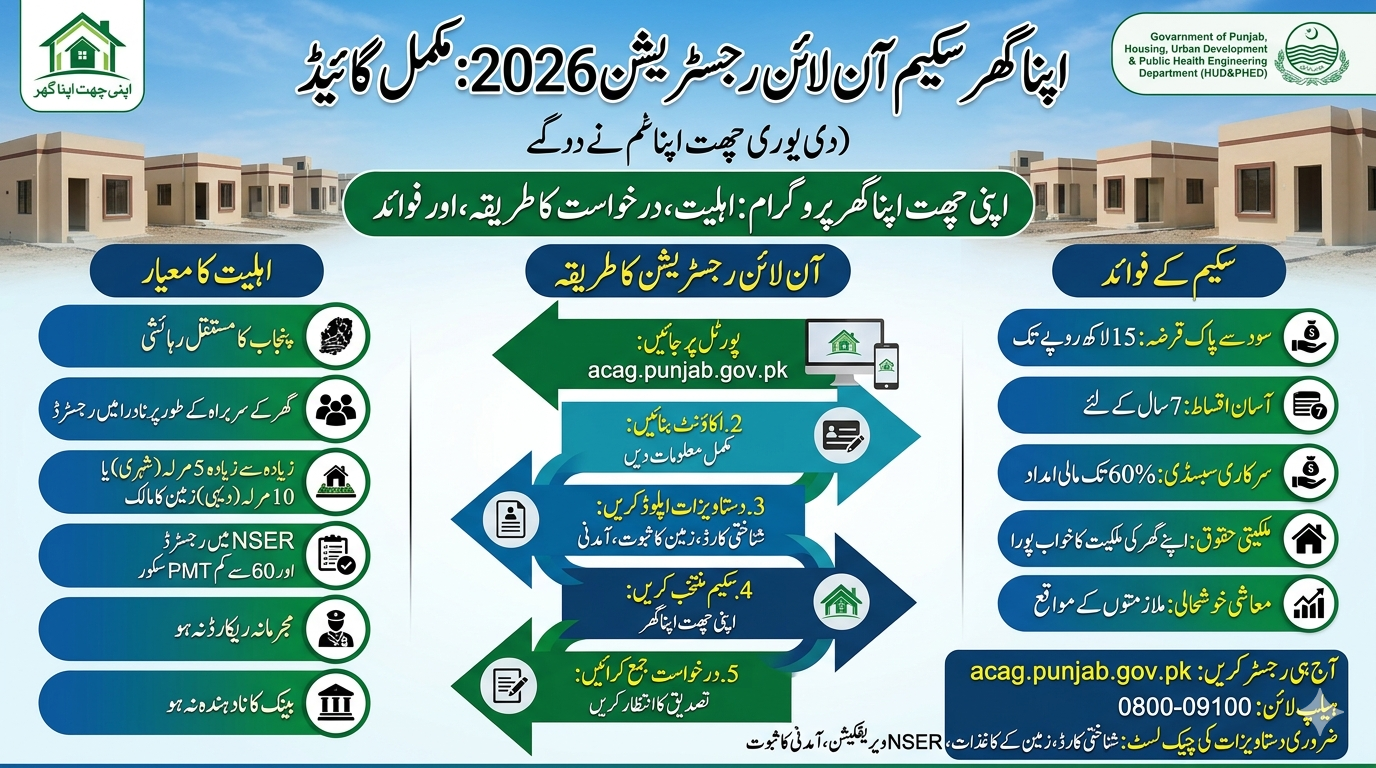
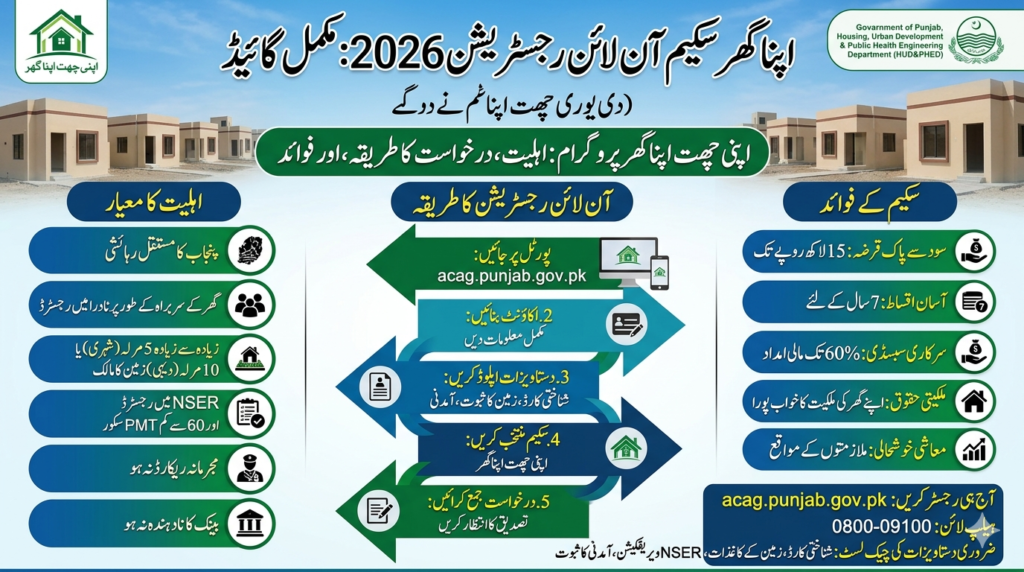
- You must be the head of your nucleus family (as per NADRA records).
- Permanent resident of Punjab according to your CNIC.
- Sole owner of land measuring 5 Marla or less in urban areas or up to 10 Marla in rural areas (for construction loan component). Land must be in your possession for building the house.
- Registered in the National Socio-Economic Registry (NSER) with a PMT score of 60 or less.
- No criminal record (especially anti-state, anti-social, or heinous crimes).
- Not a loan defaulter of any bank or financial institution.
- Valid CNIC and stable household income (typically targeting lower-income brackets).
Additional Notes: The scheme emphasizes women empowerment and joint families in expansions. Overseas Pakistanis may have limited options depending on specific phases. Always verify your NSER status first, as it’s a key filter.
Step-by-Step Guide: Apna Ghar Scheme Online Registration 2026
The entire process is 100% online, free, and designed for simplicity. No agents or middlemen are needed—avoid anyone charging fees.
Step 1: Visit the Official Portal
Go to acag.punjab.gov.pk — this is the only authorized website.
Step 2: Register / Create Account
Click on “Register” or “Citizen Registration Form.” Fill in accurate details:
- Full name (exactly as on CNIC)
- Father’s/Husband’s name
- CNIC number
- Date of birth, gender, marital status
- Complete address (district, city, postal code)
- Mobile number and email
- Family size and monthly household income
Step 3: Set Password
Create a strong password and confirm it. Save your login details safely.
Step 4: Upload Documents
Scan and upload clear copies (JPG/PDF, preferably under 2MB each):
- CNIC (front & back)
- Proof of land ownership (if applicable: registry, fard, etc.)
- NSER registration proof / PMT score details
- Income proof (salary slips, business documents, bank statements)
- Passport-size photos
- Any other verification documents as prompted
Step 5: Select Component
Choose Apni Chhat Apna Ghar (for construction on owned land) or Apni Zameen Apna Ghar (free plot for landless, when open).
Step 6: Review & Submit
Double-check all information. Submit the form. You will receive a confirmation via SMS/email with a tracking/reference number.
Step 7: Track Application
Log back in with CNIC to monitor status, download slips, and receive updates on verification, balloting, or disbursement.
Toll-Free Helpline: 0800-09100 for queries and support.
Pro Tip: Apply early. Registration windows can close without much notice, and batches are processed periodically.
Required Documents Checklist
- Valid CNIC of applicant and family head (if different).
- Land ownership documents (ownership proof, mutation, etc.).
- NSER/PMT verification.
- Income and employment proof.
- Family details and photographs.
- Bank account details (for disbursement).
Keep originals ready for any physical verification.
Benefits and Impact of the Scheme
This isn’t just a loan—it’s a comprehensive support system:
- Zero Interest: Government subsidy makes it truly affordable.
- Job Creation: Construction of 100,000 homes is expected to generate hundreds of thousands of direct and indirect jobs, boosting the local economy.
- Improved Living Standards: Access to proper housing with basic amenities reduces slums and overcrowding.
- Women & Family Focus: Many beneficiaries are women heads of households; expansions include joint families.
- Transparency: Fully digital process with minimal human intervention, high recovery rates reported (around 99% in updates).
- Long-term Stability: Families build equity instead of paying endless rent.
Real progress: By 2026, significant numbers of loans have been disbursed, homes completed, and second tranches released, showing strong implementation.
Common Mistakes to Avoid
- Using unofficial websites or agents.
- Entering incorrect CNIC or mismatched details (leads to rejection).
- Submitting blurry/low-quality documents.
- Missing NSER registration—get it done first if needed.
- Delaying application in hopes of “better phases.”
Comparison with Other Housing Schemes
Unlike federal Mera Pakistan Mera Ghar (markup subsidy through banks), Apni Chhat Apna Ghar offers direct interest-free loans with simpler access for Punjab residents owning small land parcels. It complements initiatives like Apni Zameen Apna Ghar for plot allocation.
Final Thoughts: Your Chance for a Secure Future
The Apna Ghar Scheme represents a genuine government effort to bridge the housing gap for ordinary Punjabis. If you meet the criteria, don’t wait—visit acag.punjab.gov.pk today, complete your registration, and take the first step toward owning your home.
A stable roof over your head means better education for children, peace of mind, and a foundation for generational progress. Thousands have already benefited; your family could be next.
Apply Now: acag.punjab.gov.pk
Helpline: 0800-09100
Note: Always cross-verify latest details on the official portal, as schemes evolve. This guide is based on available public information as of 2026.